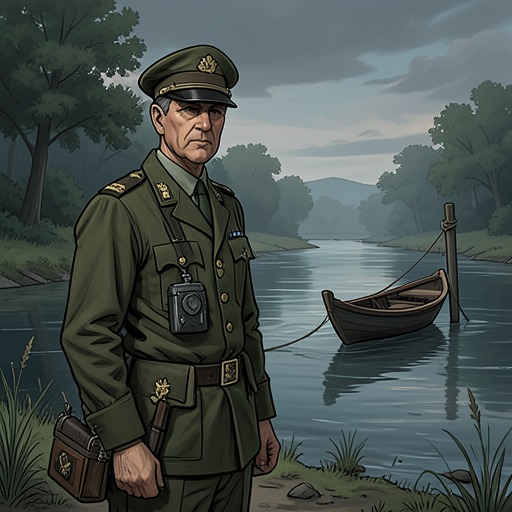
The red-painted canoe
Out Stealing HorsesThe red-painted canoe is Jon’s mother’s working boat and a quiet instrument of connection in the wartime river country. Its repeated crossings join apparently ordinary domestic help to the clandestine movement of people and mail, and its role becomes urgent when a stranded man must be brought to Trond’s father and the rescue is exposed. The canoe does not act alone: its importance lies in the human network that rows it, waits for it, and depends on what it can carry without attracting attention.
Identity and Use
The canoe belongs to Jon’s mother, who rows it upriver to the cabin where Trond’s father lives. The account describes it as a red-painted boat, an identifiable vessel within a landscape where movement on the river has practical and political consequences. Oars set into their rowlocks make its passage audible to those nearby, but the crossing can still be conducted without lights or conversation. Its plain function as transport gives it a place in an operation that must appear, whenever possible, to be something else.
The canoe is distinct from the boat Trond’s father uses. When Jon’s mother lands on the opposite bank, she pulls her vessel far enough ashore that the current cannot carry it back; the two boats are beside one another at the landing. That practical detail makes the river crossing legible as work rather than symbol alone: each boat has to be secured, and the water’s current remains a force to account for even while people face a larger danger.
Domestic Routine and the Traffic
Jon’s mother rows upriver once or twice a week. At times she carries food; at other times, or alongside it, she carries what the village calls mail. The public explanation is that she helps Trond’s father cook proper meals, because he lives alone and must remain well enough to work. The story presents this as the version Barkald gives at the shop, not as a full account of what happens on every journey. The regular crossings therefore hold two meanings at once: an act of care that can be spoken about openly, and part of The traffic, whose actual cargo and purpose are not always disclosed.
Jon’s father does not join The traffic, but he does not openly oppose it either. He looks away when his wife takes the canoe down to the river and rows toward Trond’s father. He also declines to intervene when a stranger is brought to the barn at twilight to wait for darkness before travelling upriver. The canoe’s journeys depend on this tacit noninterference as well as on rowing: a routine can continue because those who might expose it choose not to acknowledge what they see.
The river remains usable even in late autumn, when snow lies on the ground but the water has not frozen. That circumstance matters to the canoe’s work. A man in a suit arrives at Jon’s family’s farm in the early morning, inadequately dressed for the cold, and is kept in the barn through the daylight hours. When he cannot remain there quietly, Jon’s mother moves him toward the river and takes him across to Trond’s father. The boat makes a route possible at a time when the land and the danger of being seen make movement difficult.
The Crossing Under Threat
The crossing becomes precarious on the far bank. Jon’s mother has just landed beside Trond’s father’s boat and is still hauling her own vessel clear of the current when the man tries to get out. He falls, and his grip on his bag complicates the landing. The delay leaves the group exposed as a motorcycle approaches across the field. Trond’s father, hearing it, comes out from beside the cabin and recognizes that something is wrong.
In the ensuing confusion, Jon’s mother is directed to take the man’s bag and run toward Trond’s father. She does so, bent forward and moving uphill, while the soldiers’ attention remains on the landing. The canoe has brought the man across the river, but landing does not finish its work: the passengers and their belongings must get away from the water and toward shelter. Once Jon’s mother reaches the cabin, she and Trond’s father gather essential things and documents he has hidden. They then leave by the back window and flee hand in hand toward Sweden. The account does not say that the canoe carries them on this final leg; its decisive contribution is getting the man to the bank where the rescue can unfold.
Narrative Significance
The canoe’s recurring use gives material form to a concealed system without making the vessel itself a complete explanation of it. Food, mail, and a person in need of passage can move along the same river route, while the visible act of rowing remains compatible with the cover story of cooking and domestic assistance. The boat’s ordinary purpose is precisely what allows the crossings to belong to both everyday life and resistance.
The narration also gives the river journey a change in scale. In the routine crossings, the canoe is part of a repeated pattern of care and covert transport. During the rescue, the same means of travel is caught in a public emergency: the man’s failed disembarkation, the approaching motorcycle, and the rush to carry the bag uphill turn the landing into a point of immediate danger. The canoe is not presented as a heroic object or as a guarantee of safety. It enables the crossing, but the people who use it must respond to the current, the exposure of the landing, and the threat arriving from the road.
Its red paint marks an ordinary vessel in a story where ordinary appearances shelter extraordinary work. The canoe links Jon’s mother’s regular visits to Trond’s father with the final, perilous crossing that brings the stranded man within reach of escape. Through it, the river is both a boundary to be crossed and a route that sustains an otherwise hidden chain of assistance.